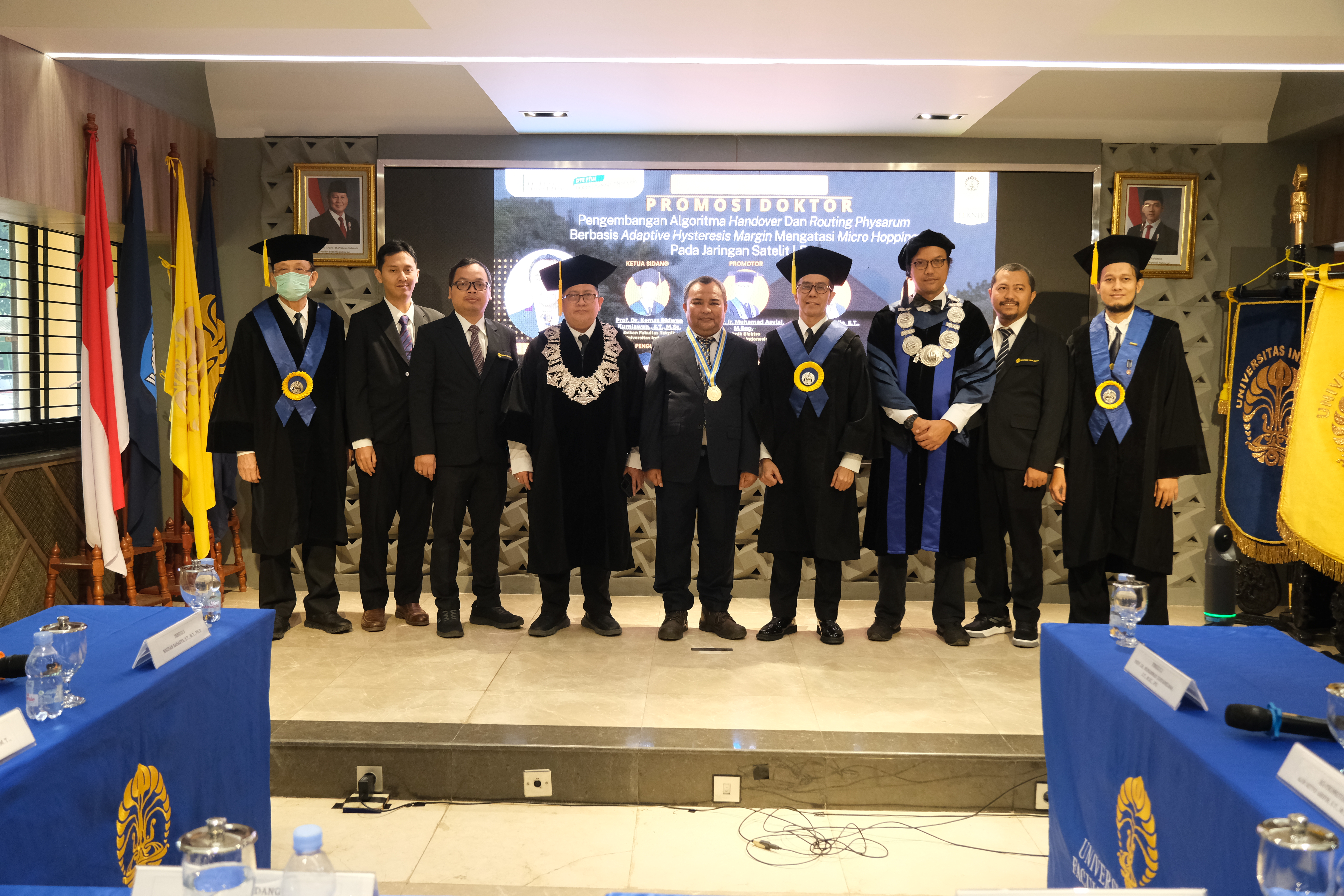
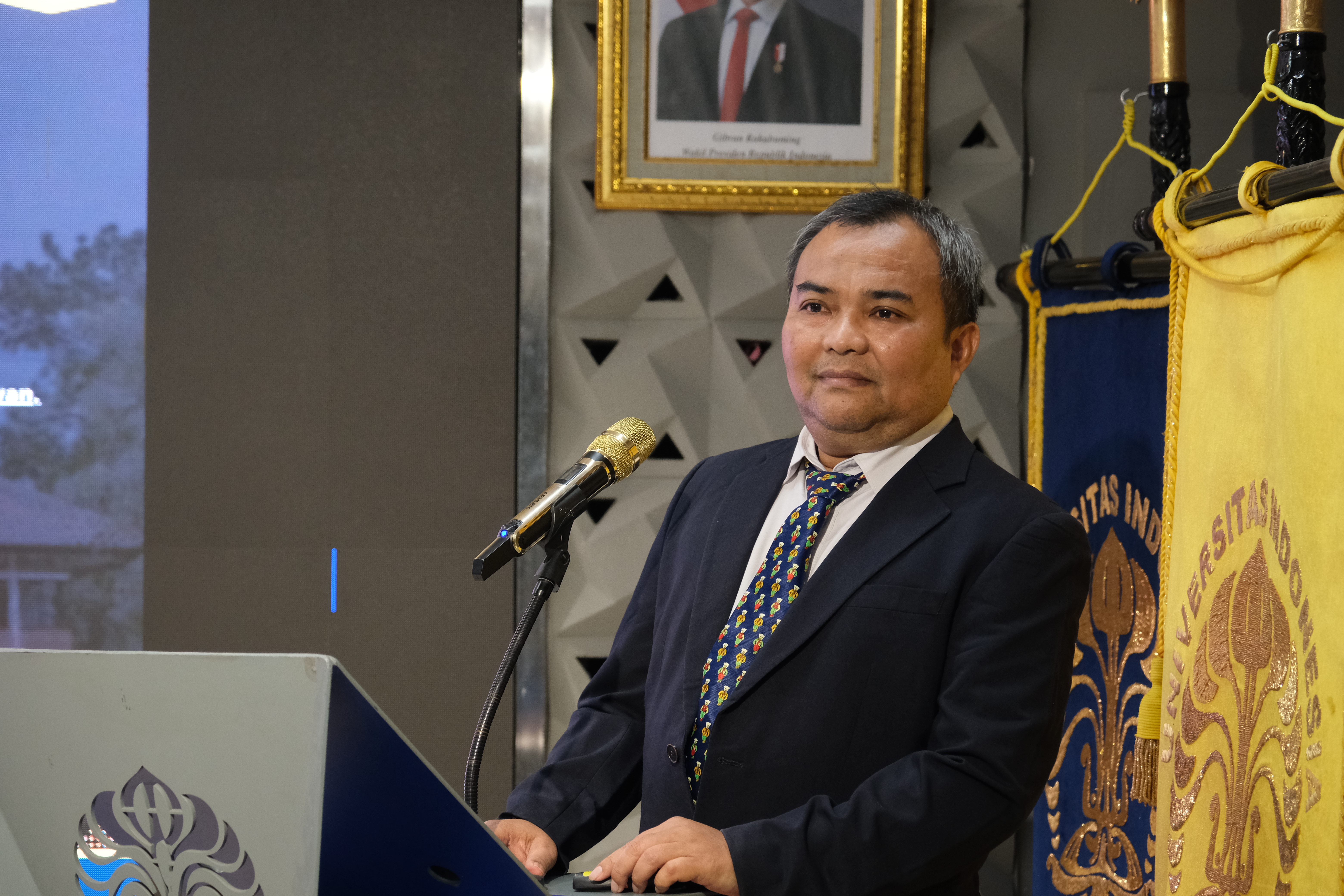
Mhd Indra Iskandar has officially earned his Doctor of Engineering degree from the Faculty of Engineering, Universitas Indonesia (FTUI) after successfully defending his dissertation during a public doctoral examination held on Friday, 26 June 2026, at the Smart Classroom, GK Building Room 304, Department of Electrical Engineering, FTUI.
In his dissertation entitled “Development of Physarum-Inspired Handover and Routing Algorithms Based on Adaptive Hysteresis Margin for Low Earth Orbit (LEO) Satellite Networks,” Indra addressed one of the most critical challenges in Low Earth Orbit (LEO) satellite constellations—maintaining stable network connectivity. LEO satellite systems have recently gained widespread attention for their ability to provide high-speed internet access to remote and underserved regions where fiber-optic infrastructure is unavailable or impractical.
“LEO satellites offer lower communication latency because signals travel faster through the vacuum of space than through optical fiber. However, their relatively low orbital altitude causes them to move at approximately 7.6 kilometers per second, meaning that a single satellite can serve a ground station for only a few minutes before moving out of coverage,” Indra explained during his presentation.
This constant movement requires the network to perform frequent handovers from one satellite to another. Conventional handover methods generally rely only on instantaneous signal strength, causing unnecessary back-and-forth switching between satellites even when the improvement in connection quality is negligible—a phenomenon known as the ping-pong handover effect. At the same time, conventional routing algorithms that simply select the nearest neighboring satellite often create inefficient looping paths instead of progressing directly toward the destination, an anomaly referred to as geodesic micro-hopping. Together, these issues contribute to unstable connections, higher latency, and reduced reliability in LEO satellite networks.
To overcome these challenges, Indra developed an integrated framework consisting of three complementary mechanisms.
For access satellite selection, he combined the Hybrid AHP–Entropy TOPSIS decision-making method with an Adaptive Hysteresis Margin mechanism. Candidate satellites are evaluated simultaneously based on three criteria: alignment with the destination ground station, the trend of elevation angle changes, and received signal strength. A handover is executed only when a candidate satellite demonstrates a performance advantage that exceeds a predefined hysteresis threshold—similar to a driver changing lanes only when the adjacent lane offers a genuinely better opportunity.
For inter-satellite routing, Indra modified an algorithm inspired by Physarum polycephalum, a single-celled eukaryotic slime mold capable of naturally forming highly efficient transport networks despite having neither a brain nor a central nervous system. Previous studies have shown that the transport networks formed by this organism closely resemble the layout of Tokyo’s railway network, which was engineered over many decades. Building upon this principle, Indra incorporated a geodesic direction vector based on the great-circle route—the shortest path between two points on the Earth’s surface—allowing each satellite to continuously guide data packets toward the destination rather than allowing traffic to spread inefficiently, as in conventional Physarum-inspired models.
As a third layer, Indra designed a stateful handshaking protocol based on request-to-send (RTS) and clear-to-send (CTS) signaling. Before transmitting data, the sending satellite first verifies the readiness of the next-hop satellite, including its temporary buffer capacity. If no response is received within the specified timeout period, buffered data are immediately redirected to the next-best candidate without recalculating the routing path from the beginning, thereby minimizing the risk of packet loss during transmission.
The proposed framework was evaluated using real orbital data from CelesTrak in a simulated satellite constellation equivalent to Starlink Shell-1, consisting of 1,584 satellites, with a data transmission scenario from Jakarta to London.
“The simulation results demonstrate that the proposed approach reduces the frequency of ping-pong handovers by 87.1% while lowering the average end-to-end latency to 59.96 milliseconds—representing improvements of 14.89% compared with the Dijkstra algorithm and 26.73% compared with Ant Colony Optimization—while maintaining a low packet loss ratio of only 1.32%,” Indra stated.
The research has been published in the internationally recognized journal IEEE Access (Scopus Q1) and received the Best Paper Award at the International Seminar on Intelligent Technology and Its Applications (ISITIA) 2025 in Surabaya.
Dean of the Faculty of Engineering, Universitas Indonesia, Prof. Kemas Ridwan Kurniawan, S.T., M.Sc., Ph.D., praised the significance of the research.
“Dr. Indra’s research addresses one of the key challenges behind the rapid expansion of Low Earth Orbit satellite networks for global connectivity, including in Indonesia. By combining the natural intelligence of a simple biological organism with the demands of modern network engineering, this work demonstrates how fundamental research can generate practical solutions for the digital infrastructure of the future. We are proud that this achievement further strengthens the academic reputation of the Department of Electrical Engineering at FTUI,” said Prof. Kemas.
Indra graduated cum laude and officially became the 202nd doctoral graduate of the Department of Electrical Engineering and the 677th doctoral graduate of FTUI.
The doctoral examination was chaired by Prof. Kemas Ridwan Kurniawan, S.T., M.Sc., Ph.D., with Prof. Dr. Ir. Muhamad Asvial, M.Eng. serving as the principal supervisor and Ajib Setyo Arifin, S.T., M.T., Ph.D. as co-supervisor. The examination committee consisted of Prof. Dr. Ir. Dadang Gunawan, M.Eng.; Prof. Dr. Muhammad Suryanegara, S.T., M.Sc., IPU.; Dr. Ir. Catur Apriono, S.T., M.T., Ph.D.; Naufan Raharya, S.T., M.T., Ph.D.; and external examiner Prof. Dr. Ir. Setiyo Budiyanto, S.T., M.T., IPU., ASEAN Eng., APEC Eng., ACPE., SMIEEE, from Universitas Mercu Buana, Jakarta.
***
Public Communications Office
Faculty of Engineering, Universitas Indonesia