

The demand for lightweight, high-strength, and cost- and time-efficient metal components is growing across various industries, including automotive, shipbuilding, and aerospace. However, metal additive manufacturing based on welding technology for aluminum materials still faces several longstanding challenges, such as high thermal conductivity, the presence of oxide layers on the material surface, and a tendency to develop porosity and solidification cracking due to rapid cooling.
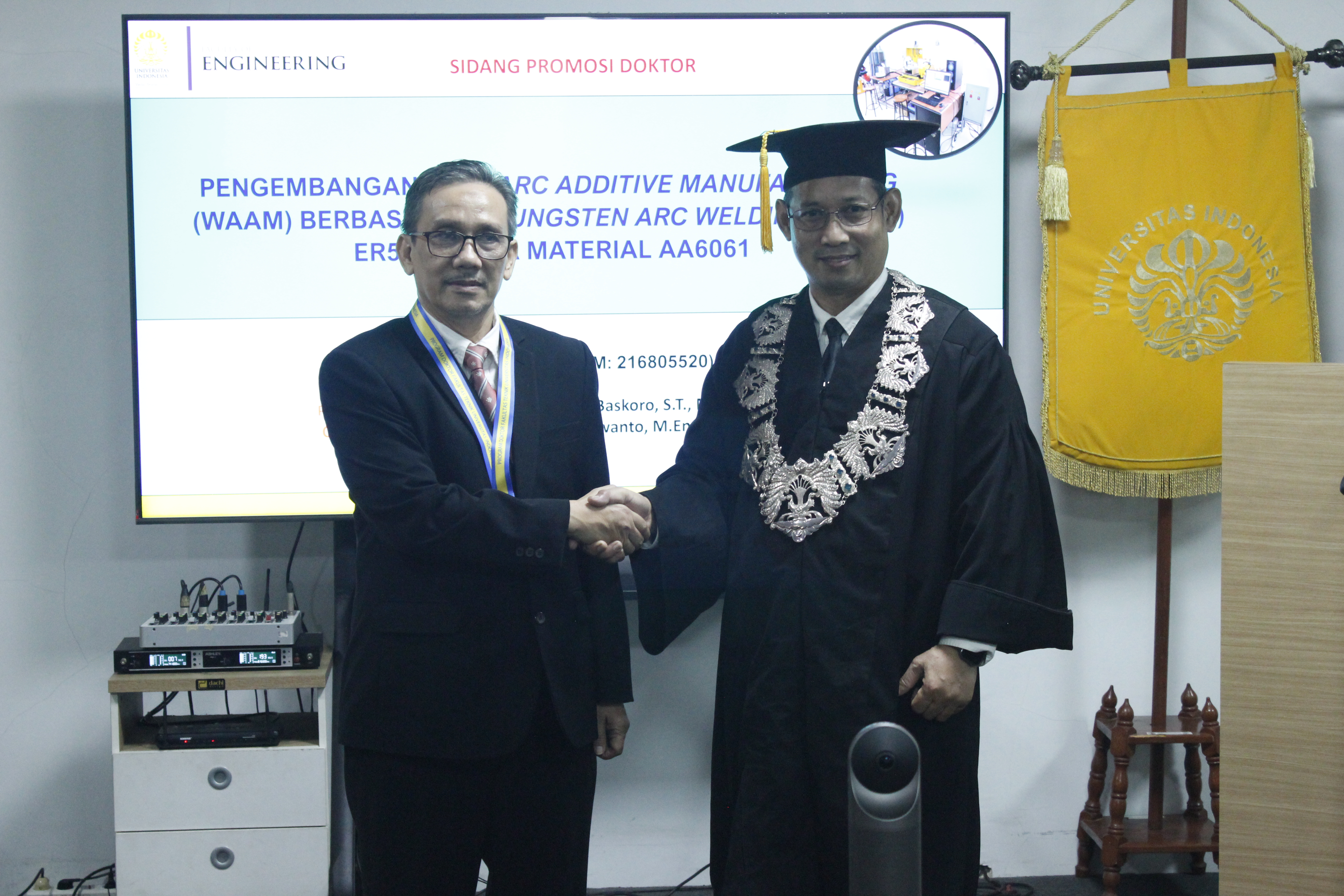
Addressing these challenges, Agus Sentana, a doctoral candidate from the Department of Mechanical Engineering at the Faculty of Engineering, Universitas Indonesia (FTUI), developed a Wire Arc Additive Manufacturing (WAAM) system based on Gas Tungsten Arc Welding (GTAW) for AA6061 aluminum alloy. Following the successful defense of his dissertation, Agus was officially awarded the title of the 137th Doctor of Mechanical Engineering and the 689th Doctor of the Faculty of Engineering, Universitas Indonesia, graduating Cum Laude with a Grade Point Average (GPA) of 3.98.
His doctoral dissertation, entitled “Development of Gas Tungsten Arc Welding (GTAW)-Based Wire Arc Additive Manufacturing (WAAM) Using ER5356 Filler on AA6061 Material,” was defended during a public doctoral examination held at GK.304 Building, FTUI, on Thursday, (2/7). The examination was chaired by Prof. Dr. Ir. Akhmad Herman Yuwono, M.Phil.Eng. The dissertation was supervised by Prof. Dr. Ir. Ario Sunar Baskoro, S.T., M.T., M.Eng. as Promotor, with Prof. Dr. Ir. Gandjar Kiswanto, M.Eng. serving as Co-Promotor.
“WAAM is an additive manufacturing method that utilizes an electric arc to melt and deposit metal wire layer by layer without the need for subtractive machining, as required in conventional manufacturing methods. This technology can reduce fabrication time by 40–60%. However, its application to aluminum remains limited because the material is highly susceptible to solidification cracking, particularly when welded using GTAW (also known as TIG welding) with filler metals whose composition closely resembles that of the base metal,” Agus explained.
This challenge is commonly addressed using ER5356 filler wire, which has a high magnesium content that improves crack resistance. Nevertheless, the process parameters must be precisely controlled to ensure stable metal deposition and minimize defects. Agus addressed this issue by designing and developing a three-axis (X, Y, Z) GTAW-based WAAM machine controlled using MACH3 software, complete with a specially designed torch holder and an intermittent, precisely controlled wire feeding system. He evaluated the WAAM-GTAW process from single-layer to multi-layer deposition by investigating the effects of welding current, torch travel speed, and wire feeding direction on the geometry, microstructure, and mechanical properties of the deposited material.
His research demonstrated that the layer symmetry coefficient and layer inclination are effective quantitative metrics for evaluating the quality and stability of WAAM-GTAW deposited layers. Through a series of experiments, Agus successfully produced aluminum alloy 5356 wall structures with relatively low porosity and uniform hardness using an optimal combination of 100 A welding current and 80 mm/min travel speed. Under these conditions, the deposited material achieved a maximum tensile strength of 295.73 MPa, surpassing the results reported in several previous studies. According to Agus, these findings can serve as an important reference for the further development of GTAW-based WAAM technology for aluminum alloys.
Further evaluation using X-ray radiography, however, revealed that the WAAM-GTAW structures still contained defects in the form of porosity and inclusions. These defects are believed to originate from hydrogen trapped during solidification as well as contaminants present in the filler wire and base material. The findings highlight that controlling hydrogen contamination and ensuring material cleanliness remain critical aspects requiring further optimization in the future development of GTAW-based WAAM for aluminum.
In his closing remarks, Prof. Dr. Ir. Akhmad Herman Yuwono, M.Phil.Eng., Chair of the Examination Committee, congratulated Agus on successfully defending his dissertation. He also praised the research as an important contribution to the Department of Mechanical Engineering FTUI’s efforts to strengthen Indonesia’s capabilities in metal additive manufacturing technology while opening new opportunities for further research on other metal alloys widely used in precision manufacturing industries.
The public doctoral defense was attended by the examination committee, consisting of Prof. Dr. Triyono, S.T., M.T. from the Faculty of Engineering, Universitas Sebelas Maret Surakarta, Prof. Dr. Ir. Winarto, M.Sc., Prof. Sugeng Supriadi, S.T., M.S.Eng., Ph.D., Prof. Dr. Yudan Whulanza, S.T., M.Sc., and Jos Istiyanto, S.T., M.T., Ph.D. Following the successful defense before the examination committee, Agus Sentana was officially conferred the degree of Doctor of Engineering from the Faculty of Engineering, Universitas Indonesia.
***
Public Communications Office
Faculty of Engineering, Universitas Indonesia


