


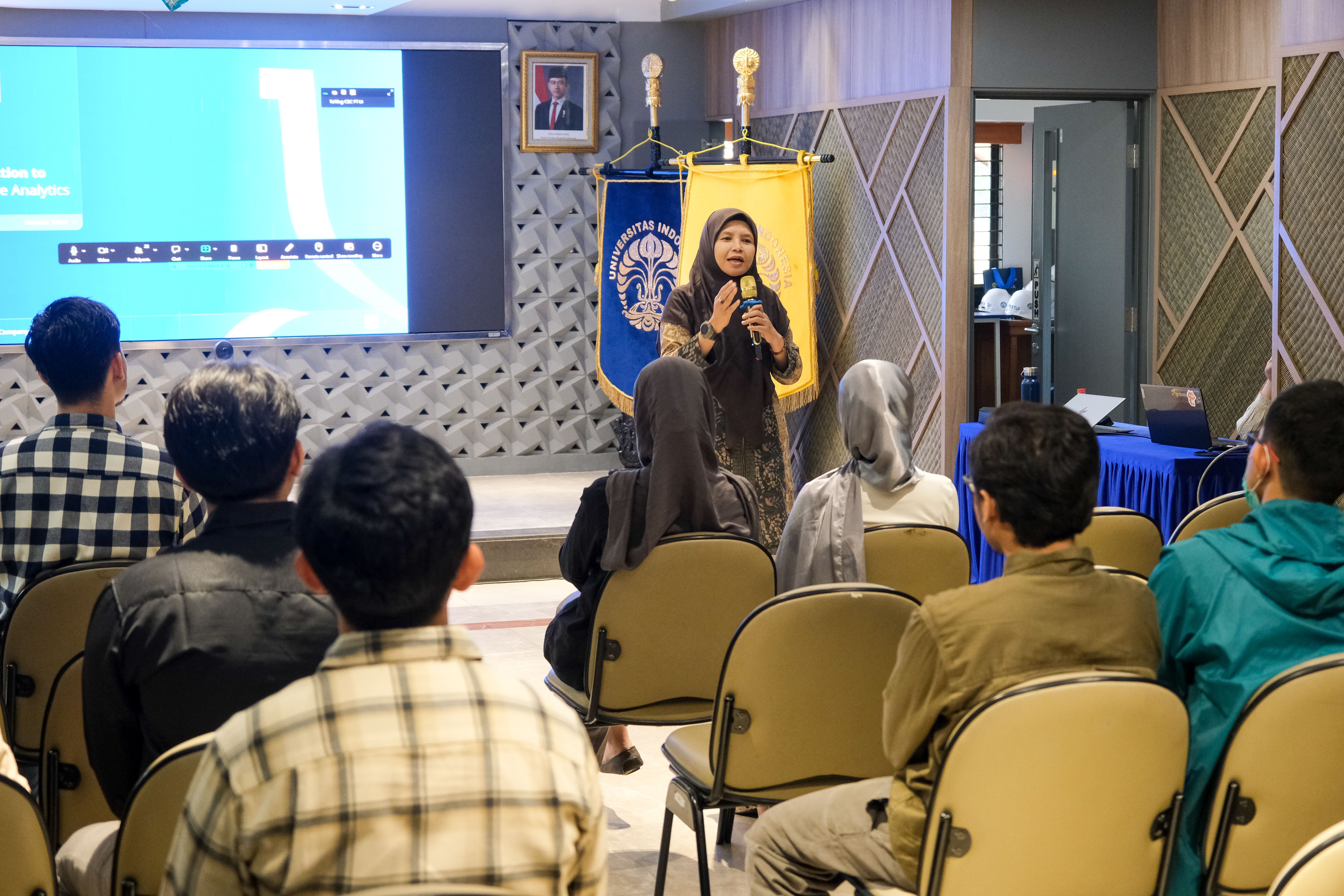
FTUI CDC Introduces Data-Driven Problem Solving through Lean Six Sigma Seminar
The Career Development Center of the Faculty of Engineering, Universitas Indonesia (CDC FTUI), held a seminar on Lean Six Sigma as part of the Engineering Career and Internship Fair (ECIF) 2026 series. Held at the Smart Meeting Room, FTUI Dean’s Building, on September 17, the seminar carried the theme “From Data to Decision: Lean Six Sigma, Problem-Solving Skills for the AI Era.”
The seminar was designed to introduce students to a systematic approach to problem-solving while providing insights into how data and technology can be leveraged to support more informed decision-making in addressing challenges in the industrial sector.
The seminar featured Siti Hartinah Ahmad, Director of The Lean Six Sigma Company Indonesia, as the first speaker. In her presentation, Siti introduced the concepts and principles of Lean Six Sigma as an approach that helps organizations identify problems, reduce waste, improve process quality, and achieve measurable improvements.
Lean Six Sigma is becoming increasingly relevant amid evolving workforce competency requirements. According to the seminar materials, which referenced the World Economic Forum, skills such as analytical thinking, AI and big data, and creative thinking are among the key competencies needed to navigate the future of work.
“Through the Lean Six Sigma approach, students are introduced to a structured problem-solving process, beginning with defining the problem, measuring the current condition, analyzing the root causes, determining improvement measures, and ensuring that the improvements can be sustained. The approach also places data at the center of understanding process conditions and making informed decisions,” explained Siti Hartinah.
In a separate statement, Prof. Kemas Ridwan Kurniawan, S.T., M.Sc., Ph.D., Dean of the Faculty of Engineering, Universitas Indonesia, emphasized the importance of balancing technological capabilities with human-centered problem-solving skills.
“In the AI era, the ability to use technology needs to go hand in hand with the ability to understand problems, interpret data, think critically, and make decisions. Engineering education is not only about preparing students to master technology, but also about developing their ability to use technology to address real-world problems responsibly and innovatively,” said Prof. Kemas Ridwan Kurniawan, S.T., M.Sc., Ph.D.
In addition to the Lean Six Sigma session, the seminar featured Dawera Taher, a Lean Six Sigma Master Black Belt, who delivered a session entitled “Introduction to Predictive Analytics.” The session broadened the discussion by introducing the use of predictive analytics and machine learning to support decision-making and accelerate problem-solving within the Lean Six Sigma framework.
In his presentation, Dawera explained the relationship between data quality, measurement processes, and levels of analysis in generating actionable information to support decision-making. Predictive analytics enables organizations not only to understand what has happened, but also to leverage data to gain insights and make predictions about potential future conditions.
This approach is becoming increasingly important as industries generate ever-growing volumes of data. However, data availability alone is not sufficient. Data needs to be properly managed and analyzed so that it can be translated into relevant information and insights that address organizational needs.
Through this seminar, CDC FTUI reaffirmed its commitment to preparing students for the continuously evolving demands of the workplace. Analytical thinking, the ability to leverage data and technology, and creative problem-solving are increasingly important competencies across various industrial sectors.
Furthermore, through the Engineering Career and Internship Fair (ECIF) 2026 series, CDC FTUI continues to strengthen the bridge between academia and the professional world. In addition to providing access to career and internship opportunities, the series provides students with opportunities to gain first-hand insights from industry practitioners into the competencies, technologies, and problem-solving approaches required in the workplace.
By integrating an understanding of Lean Six Sigma, data analytics, predictive analytics, and AI, the seminar is expected to broaden FTUI students’ perspectives on workplace readiness. Entering the professional world requires not only mastery of a particular discipline, but also the ability to process information, solve problems systematically, and adapt to technological developments.
***
Public Communication Office
Faculty of Engineering, Universitas Indonesia

